
South Africa’s education sector is ambitious, complex, and underserved by generic software platforms. Schools, TVET colleges, training providers, and higher education institutions face a unique combination of challenges: strict regulatory reporting requirements, unreliable internet connectivity, constrained budgets, and a pressing need to extend learning access to more students.
Yobi Code builds custom education software designed from the ground up for the South African context, with the flexibility to scale as institutions grow.
Key takeaway: Custom education software gives South African providers control over compliance, connectivity, and long-term scalability – without adapting their operations to fit a foreign platform.
What Is Custom Education Software — and Why Does It Matter in South Africa?
Custom education software is technology built specifically around the workflows, regulatory requirements, and operational realities of a particular institution — rather than a generic platform that forces institutions to adapt their processes.
In South Africa, this distinction is critical. According to Statistics South Africa, millions of learners are enrolled across more than 23,000 public schools and hundreds of registered private providers. These institutions operate in vastly different contexts — from well-resourced urban campuses to rural schools with intermittent electricity.
A platform built for a British university or an American K-12 school will not account for these conditions. Custom software does.
What custom education software typically includes:
- Student information and administration systems (SIS)
- Learning management systems (LMS) adapted for local curricula
- Automated regulatory reporting (SETA, DBE, and DHET returns)
- Fee management and financial tracking
- Parent and student communication portals
- Analytics and performance dashboards for school leadership
Reliable Systems for Low-Connectivity and Low-Resource Environments
South Africa’s digital infrastructure presents real operational constraints. According to the International Telecommunication Union (ITU), a significant portion of South Africans still lack consistent broadband access — a reality that education software must accommodate, not ignore.
Yobi Code designs platforms with low-resource environments at the centre, not as an afterthought.
Offline-First Design for South African Conditions
Systems are architected to function in environments with limited or intermittent connectivity, synchronising data automatically when a connection is restored. This ensures educators and administrators can continue their work without disruption during load shedding or in areas with poor signal coverage.
Systems are architected to function in environments with limited or intermittent connectivity, synchronising data automatically when a connection is restored. This ensures educators and administrators can continue their work without disruption during load shedding or in areas with poor signal coverage.
Multi-Device Compatibility Without Sacrificing Performance
Institutions use a wide range of devices — from older desktop computers to entry-level Android smartphones. Every platform Yobi Code builds is tested across device types and connection speeds to ensure consistent, reliable performance.
Built for South African Compliance: SETA, DBE, and POPIA Requirements
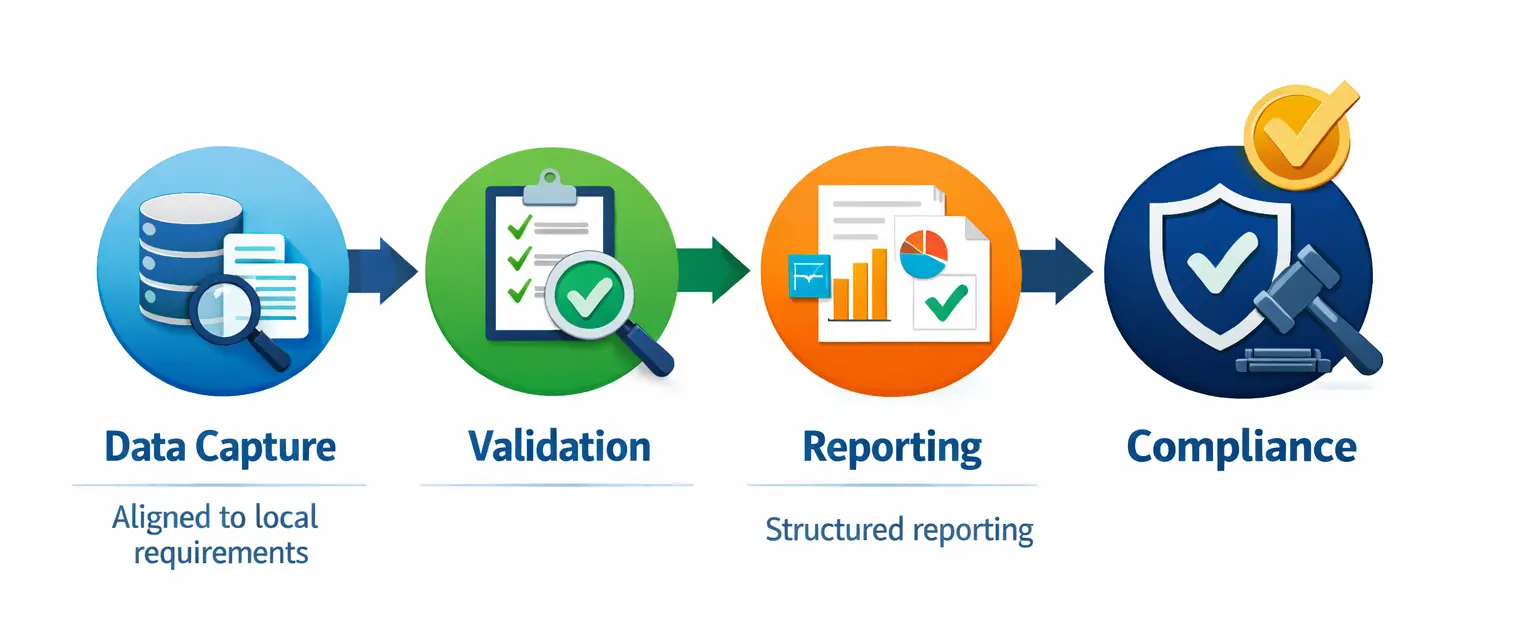
Education institutions in South Africa operate within a demanding regulatory environment. Training providers registered with SETAs (Sector Education and Training Authorities) must submit learner achievement data through the NLRD (National Learners’ Records Database), managed by SAQA. Schools must align with DBE reporting requirements. All institutions must comply with the Protection of Personal Information Act (POPIA), which governs how student data is captured, stored, and shared.
Generic platforms often require manual workarounds to meet these requirements — adding administrative burden and creating compliance risk. Yobi Code builds these requirements directly into the system architecture.
Automated Reporting and Data Capture
Rather than manually compiling reports from multiple data sources, institutions using custom-built systems can generate SETA, DBE, or internal board reports directly from the platform — reducing errors, saving time, and ensuring audit-readiness.
POPIA-Compliant Data Management for Student Records
Student data — including personal information, academic records, and financial details — is handled with full POPIA compliance built in: consent tracking, access controls, data retention policies, and breach notification protocols.
Scalable Architecture That Grows With Your Institution
South Africa’s education sector is expanding. The Department of Higher Education and Training (DHET) continues to drive growth in post-school education and training, with an emphasis on increasing enrolment and broadening access.
The technology institutions deploy today should be built to support growth tomorrow — not replaced when growth arrives.
Every system Yobi Code designs uses scalable cloud architecture, meaning platforms can accommodate increasing user volumes, additional service lines, new campuses, and evolving digital learning models without requiring a rebuild.
From Single Campus to Multi-Site Operations
As institutions expand across regions, the platform expands with them. Reporting, access controls, and data management are structured to support multi-site operations from day one.
Integrating Digital Learning Models Without Disruption
Whether an institution is introducing blended learning, e-learning modules, or digital assessment tools, the underlying architecture supports these additions — no costly integrations or system replacements required.
Why South African Education Providers Choose Custom Software Over Off-the-Shelf Platforms
The appeal of off-the-shelf education management platforms is understandable: lower upfront cost, faster deployment, and established feature sets. But for South African institutions specifically, these platforms consistently create downstream problems:
- Compliance gaps that require manual workarounds
- Connectivity assumptions that don’t reflect local infrastructure
- Licensing costs in foreign currencies that escalate unpredictably
- Vendor roadmaps that don’t account for South African regulatory changes
- Limited ability to customise for local workflows or reporting formats
Custom software inverts this equation. The upfront investment is in a system built entirely around the institution’s actual operations, compliance requirements, and growth goals — meaning the software works for the institution, not the other way around.
Frequently Asked Questions About Education Software in South Africa
1. What types of education providers does Yobi Code work with?
Yobi Code works with a range of education institutions, including private schools, TVET colleges, corporate training providers, SETAs, higher education institutions, and online learning businesses. Every solution is scoped to the institution’s specific regulatory, operational, and growth requirements.
2. Can the software integrate with existing tools we already use?
Yes. Custom software is designed to integrate with existing tools including accounting systems, communication platforms, and learning management systems rather than requiring a complete replacement of existing infrastructure.
3. What does the development process look like?
Yobi Code follows a collaborative design and development process: discovery and requirements mapping, system architecture design, iterative development and testing, and ongoing support and retainer arrangements post-launch.
Build education software designed for the South African context.
Every institution is different. The right system should reflect that.
🤝 Talk to Yobi Code – no obligation, just clarity.
Don’t forget to follow us!


